








Making the Case for Moving the Sun to Hartford
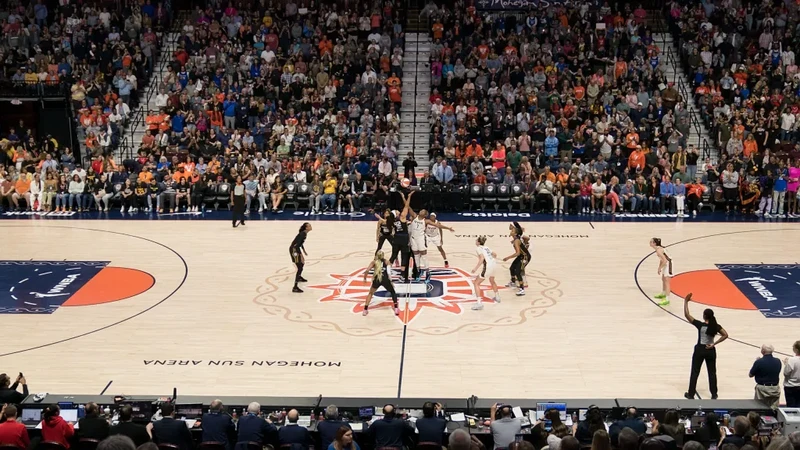
If sources mentioned in a recent New York Times article are to be believed, the WNBA is not seriously considering former Milwaukee Bucks owner Marc Lasry’s offer to move the Connecticut Sun from Uncasville to Hartford.
This seems like one of the biggest missed opportunities in their history if they don’t ultimately agree to the move, a miss that would hurt the league, hurt the sport, and hurt the state, all in the quest for unpromised riches in distant lands.
Whatever reasons they may have internally, the WNBA’s Board of Governors should seriously consider the Lasry offer before discounting it out of hand.
Despite perceptions from those around the country (and even many in our own state), Hartford is not a “small market,” at least when compared to other professional sports markets we.
Per 2024 figures, the Hartford-New Haven DMA is the 32nd largest media market in the country with 1.06 million TV households.
That means our media market is bigger than the likes of Kansas City, Las Vegas, Austin, Jacksonville, or Oklahoma City, and its the largest media market without a Big 5 sports franchise.
Hartford Has It
Our media market is also far denser, encompassing an area smaller than the city of Houston (we’ll come back to Houston in a minute).
A place like the Denver DMA meanwhile covers almost the entire state of Colorado while the Hartford DMA doesn’t even extend to Central or Western Massachusetts, an important consideration when we’re projecting potential attendance.
It’s entirely reasonable that a Hartford WNBA team could achieve greater attendance than the 2024 league average.
The total population within the Hartford-New Haven-Waterbury CBSA is 2.67 million people, with well over one million within an hour of downtown.
In addition to being the confluence of I-91 and I-84, trains passing through Hartford carry hundreds of thousands of passengers each year and Bradley International saw 3.3 million enplanements in 2024, not far behind the likes of Jacksonville, Columbus, or Cincinnati and ahead of places like Milwaukee, Buffalo, and Charleston.
With an arena with a capacity of 16,294, it’s entirely reasonable that on location alone, a Hartford WNBA team could achieve greater attendance than the 2024 league average of 11,085 per game.
All You Need Is Attention
Despite some of the inherent strengths of Hartford and its metro area, there is no denying that it is a significantly smaller area than some of the other cities that the WNBA has or is considering for expnasion.
Recent expansions to Cleveland, Detroit, the San Francisco Bay Area, and Toronto are obviously big markets, although Portland, Oregon is only slightly larger than Hartford-New Haven.
The WNBA could see a smaller addressable markets in these places compared to Hartford.
And then of course there is Houston, the country’s sixth largest media market, where the league would like to expand.
On its face, the decision to favor cities like this over Hartford seems reasonable, however its also reasonable to wonder whether the sports market in many of these cities is saturated in a way such that the WNBA could see a smaller addressable markets in these places compared to Hartford.
Take Houston for example: the city has 2.797 million TV households in its area and a metro population of 7.1 million, over two-and-a-half times larger than the Hartford-New Haven region.
Competing for Fans
In any industry, entrants have to consider their competition, of which there is plenty in Houston.
While the WNBA benefits from playing in the summer, off the schedule of the NFL, NBA, and college football, Houston still plays host to 81 games for the Houston Astros, 17 home games for the Houston Dynamo of MLS, and 13 games for the Houston Dash of the NWSL.
One might point to that and suggest attention is spread thin in a place like Houston, which might explain why the Houston Dynamo are frequently among the least attended teams in MLS and the Dash saw an average attendance of just 6,324 in 2024 during a season where the NWSL broke its attendance record (11,250 per game).
The Astros are a different story, but also illustrative of the challenge that Houston teams face at attracting attendance.
One of the best teams in baseball over the past decade, the Astros have averaged somewhere between the high 20,000 and mid-30,000 in attendance over that span of dominance.
In any industry, entrants have to consider their competition.
Back in 2012 when they lost 107 games and finished last in the AL West, they averaged just 19,848 for home games.
That season was also the best attended season for the Houston Dynamo in its history, when it averaged 20,985 for the season, slightly above the league average.
The Dynamo also happened to be a decent team that year, finishing eighth in the 19-team league and making it to the MLS Cup Finals.
By 2016, the Astros were good again, the Dynamo was bad, and attendance dropped back to an average of just 17,500 while MLS attendance continued to grow.
What happens in a future where the Astros slump again, but you have an NWSL team and potentially a WNBA team, in addition to the Dynamo, all vying for eyes?
Drawing Fans
Hartford—on the other hand—does not have the same competition, and we needn’t look further than the Hartford Yard Goats for evidence.
When Dunkin’ Park opened in 2017, the team averaged 5,812 in attendance and in multiple games experienced standing-room only in its 6,100 seat park.
Since then, not much has changed and they have led the league in attendance multiple times, attracting on average more than 400,000 fans across the whole season (more than the aforementioned Houston Dynamo have ever attracted in a season, albeit over more games).
The Hartford Athletic boasts an enviable stable of corporate supporters and sponsors.
Mind you, this is for the Double-A affiliate of the Colorado Rockies. The park is gorgeous and it’s a family atmosphere, but more importantly it reflects the latent demand for sports in the Hartford area.
Outside of the 16 home games that UConn men’s and women’s basketball teams lay in Hartford each winter (which are almost always sold out), there is no other high-caliber sporting event in striking distance, especially during the summer.
We see strong support in other sports too. When teams like the U.S. men’s national soccer team come to town to play a friendly in East Hartford, they routinely get 35,000-plus in attendance, while the team often struggles to get 30,000 for competitive matches in major markets.
The Hartford Athletic is averaging 4,757 fans per home game this USL season at 5,500-seat capacity Trinity Health Stadium and boasts an enviable stable of corporate supporters and sponsors.
Fan Commitment
Connecticut needs sports, and the squads that decide to come here do so with resounding success.
The attention factor might be even more important for the players themselves. There have been rumblings that part of the reason that the Players’ Association doesn’t want to move to Hartford is because it doesn’t have the same commercial opportunities for the players there.
No offense to the WNBA, but if you are the best player on the Houston WNBA team you are maybe the 10th most important athlete in Houston? (Perhaps a player like Caitlin Clark would be the lone exception.)
This is a place where people wear the jersey of a hockey team that left nearly 30 years ago.
If you’re in Hartford, you are the most important pro athlete in Connecticut. Paige Bueckers just finished a season where she was one of the highest paid athletes in all of college sports and one of the top selling jerseys in the country while playing a quarter of her games in Storrs.
We can debate the reasons for her success, but there’s no denying that a big part of it is the notoriety basketball players get here in this state.
If people doubt our residents’ commitment to our teams, I remind them this is a place where people wear the jersey of a hockey team that left nearly 30 years ago, not because it’s cool, but because we hold out hope that one day they’ll be back and we can say “I never stopped thinking about you.”
Whether its better to be a big fish in a small pond or a small fish in a big pond is always up for debate, but in Hartford, these players would be big fish in a bigger pond than people realize.
Fever Prescription?
The WNBA has been more popular than ever, but I wonder how durable that is. Week after week, games are setting attendance records and viewership records, but under the hood that immense growth comes down to one thing: Caitlin Clark.
The league has already set an attendance record with almost a month to go in the season, but almost every one of those individual game records came when the Indiana Fever came to town.
In fairness, that has also had spillover effects, and ratings in games without Clark are the highest they’ve ever been, but those games still attract less than half of the viewership of Fever games.
The trend looks a bit like the “Beckham Effect” in MLS. When Beckham joined the Los Angeles Galaxy in 2007, his arrival reawakened a league that had struggled to grow in its early years of existence.
The WNBA has been more popular than ever, but I wonder how durable that is.
His star power brought a new fandom to a sport that was largely an afterthought in this country. However, it’s not as if it brought MLS to the mainstream—it’s not even the most popular soccer league on TV in the U.S.
MLS had the benefit too of an endless stream of international superstars coming to the league after Beckham, with names like Zlatan Ibrahimovic, Carlos Vela, Wayne Rooney, and Gareth Bale drawing big crowds in their own right, culminating in the ultimate draw: Lionel Messi.
Meanwhile, if not for Messi, it looks like MLS ratings are plummeting.
Does the WNBA have a post-Caitlin plan as grand as Zlatan Ibrahimovic or Lionel Messi? How do you top a generational talent like her?
UConn Legacy
A team in Hartford seems like the kind of place to cultivate a following needed for appeal beyond one player. Good teams with strong followings don’t need massive markets, passion for a team can permeate across markets if it has the right ingredients.
Green Bay comes to mind as an example of a franchise that punches well above its weight, not because of its market but because of the history it stands for.
A WNBA team that represents Connecticut basketball is exactly the kind of recipe that could mimic what the Pack has and provide attentional durability beyond Clarkmania.
I acknowledge that I’m biased, seeing as I love Connecticut and UConn basketball, but in some ways that bias shows the deep roots our communities have to the game.
I’m biased, but in some ways that bias shows the deep roots our communities have to the game.
Geno Auriemma won his first championship when I was two years old. Between when I went to kindergarten and when I graduated from high school, I watched UConn win six national championships and go to nine Final Fours.
My girlfriend still has a pair of basketball shoes signed by Diana Taurasi from when she won Defensive Player of the Week at her basketball camp as a kid. If memory serves right, I think we had a Diana Taurasi “Got Milk?” ad in our high school cafeteria.
After both my grandmothers passed away, my grandfathers would find comfort spending time together sitting midcourt at UConn women’s games for years until they both passed as well.
To this day, if I’m talking with anyone in my family between the months of December and April, we can always keep the conversation going as long as someone asks, “Did you see UConn win by 40 again last night?”
Unmet Opportunity
These are just some of my stories, but what makes Connecticut special is that I would bet all of the money in my pockets against all of the money in your pockets that you could pick any random Nutmegger off the street and they probably have a story to tell about UConn women’s basketball.
Elsewhere in the country, people view women’s basketball as “up and coming.” In Connecticut, we know that it’s already arrived.
Is there anywhere else in this country with that kind of cultural lineage for women’s sport?
Is there anywhere else in this country with that kind of cultural lineage for women’s sport? If there is one I haven’t heard of it.
Letting that opportunity go unmet is not “strategic” for the WNBA, it’s the kind of shortsighted thinking that can make it better than it is today, but never as great as it could be.
Also, I would really like having a team here … please.
About the author: Dustin Nord is director of the CBIA Foundation for Economic Growth & Opportunity.
RELATED
EXPLORE BY CATEGORY


Stay Connected with CBIA News Digests
The latest news and information delivered directly to your inbox.

CBIA IS FIGHTING TO MAKE CONNECTICUT A TOP STATE FOR BUSINESS, JOBS, AND ECONOMIC GROWTH. A BETTER BUSINESS CLIMATE MEANS A BRIGHTER FUTURE FOR EVERYONE.