







Smart AI Adoption: Lessons for Small Businesses

While Vancord vice president of security Jason Pufahl was at home eating dinner one night, his email inbox was working at his office on his behalf.
He was testing an AI assistant when it unexpectedly took over a sales conversation he wasn’t necessarily interested in continuing.
“Our call was great. I can’t wait to talk with you again,” it replied on Pufahl’s behalf—followed by setting up a meeting at a Hartford hotel, complete with an explanation for the venue choice.
“It was a really awkward conversation,” Pufahl told attendees at at the Feb. 24 Connecticut Technology Summit in Bristol.
He shared the story not to scare people away from using AI, but to show that while the technology’s benefits are real, human oversight is essential.
Best Practices
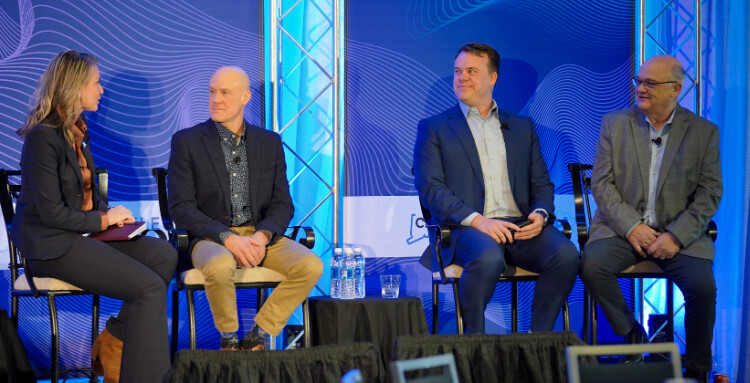
Pufahl joined Charles IT founder and CEO Foster Charles and CoopSys founder and CEO Bob DeLisa, who discussed implementation best practices with Connecticut Department of Economic and Community Development director of innovation and entrepreneurship Jessica Dodge.
From Microsoft Copilot and OpenClaw to Fyxer, the executives shared common uses for the tools.
“I think the use case for most of us is making information available to people that is usually difficult,” explained Charles.
He said at Charles IT they are using AI to help employees navigate enterprise resource planning systems.
“We’re just making it natural language,” Charles said.
Charles explained that they’re making it easy for someone to ask a simple prompt and get an answer, without having to dig through the intricacies of their system.
Governance Before Deployment
Given the range of easily accessible AI tools, the company leaders stressed the importance of governance before deployment.
DeLisa urged companies to avoid letting employees experiment with free, unsecured AI platforms.
He said many clients purchase licenses and don’t do much with them, leaving employees to bring their own tools.
Before CoopSys even started using the tools, they went through their data and set up protections.
Pufahl echoed that concern, especially where customer data is involved.
“We’re really careful about keeping all of that data separate,” he said.
Upskilling
Once the companies put governance practices in play, they said they encourage employees to explore.
“I have an expectation that people utilize AI at this point,” Pufahl said.
“Use the tool, learn the tool, but then understand the business well enough to make sure the output reflects what we actually want.”
Charles believes the tools will not replace jobs, but give employees the ability to do more difficult tasks and reframe their scope of work.
“Use the tool, learn the tool, but then understand the business well enough to make sure the output reflects what we actually want.”
Vancord’s Jason Pufahl
“The optimism I have—and I think the efficiency gain—is really about taking entry level people, or people that are mediocre, and being able to upscale them and give them the ability to do things they wouldn’t normally be able to do.”
Charles said AI tools are successful in helping sharpen someone’s thinking.
While someone might be able to use their brain and solve a problem or complete a task in 15 minutes, they could learn to ask the right questions for what they need and solve the problem with AI’s help in five minutes.
“It really forces you to think about what is the outcome that I want, and what questions do I need to get there,” Pufahl said.
Building Culture
Ultimately, AI adoption requires commitment and planning. Business leaders said a good place to start is by fostering conversation and practical use.
To build that culture, DeLisa launched an internal working group that met twice monthly over pizza.
“We talked about AI, what are you using AI for in your in your daily job, here are some cool things that we’re doing,” he said.
“We’re trying to create an ecosystem where the different bots and agents can all actually interact with each other.”
Charles IT’s Foster Charles
At Charles IT, Charles said they tried to give people the runway to experiment and automate different tasks, but they found people were solving problems that didn’t need to be solved.
Now, Charles said he brings in a small group twice monthly, discusses problems that need to be solved and then asks teams to solve that particular problem with a specific tool.
“We’re trying to create an ecosystem where the different bots and agents can all actually interact with each other and be able to work with it,” Charles said.
The 2026 Connecticut Technology Summit: The AI Revolution was a collaboration between CBIA and the Department of Economic and Community Development’s Office of Innovation and made possible through the generous support of Hinckley Allen, with additional support from Google, Amazon, Charles IT, and CoopSys.
RELATED
EXPLORE BY CATEGORY



Stay Connected with CBIA News Digests
The latest news and information delivered directly to your inbox.

CBIA IS FIGHTING TO MAKE CONNECTICUT A TOP STATE FOR BUSINESS, JOBS, AND ECONOMIC GROWTH. A BETTER BUSINESS CLIMATE MEANS A BRIGHTER FUTURE FOR EVERYONE.