








Addressing Employee Burnout, Mental Health Issues

Employee support is critical for a loyal, satisfied, and productive workforce.
“No news here, we know that we’re in unprecedented times,” Teresa Bucello, partner and health practice leader at Mercer Connecticut, told an audience of 130 business leaders at CBIA’s May 10 Healthcare’s Future: The Post-COVID World conference in Rocky Hill.

“The talent market is heating up, and unfortunately, the number of U.S. job openings has risen to 11.5 million, which is staggering.
“U.S. workers are leaving at unprecedented levels. We have quit rates at 3% for March of 2022, which is back up to the highs that we saw in November.”
Bucello detailed the major reasons for employee fatigue, and provided solutions for employers.
‘Burned Out’
She attributed the record high number of people quitting to a shift in employee needs.
“Seventy-seven percent of employees are saying that they feel burned out,” she said, “and more than 91% are saying that stress has impacted the quality of their work.”
“We need to demonstrate to our employees that we hear their needs, that we care.”
Mercer’s Teresa Bucello
Bucello said employee hardship hurts companies because “that’s our productivity, that’s our business, that’s our bottom line, that’s the care that we’re providing patients.”
The solution, she added, was to listen to employees and provide what they need for a productive work environment.
“We need to demonstrate to our employees that we hear their needs, that we care, and that we’re committed to supporting them,” she said.
Top Issues
Citing a Mercer conjoint survey of employees, Bucello highlighted some of the most important issues for both low and high wage workers.
The top concerns for low wage workers were making ends meet, physical and mental health, and financial wellness, including retirement and debt.
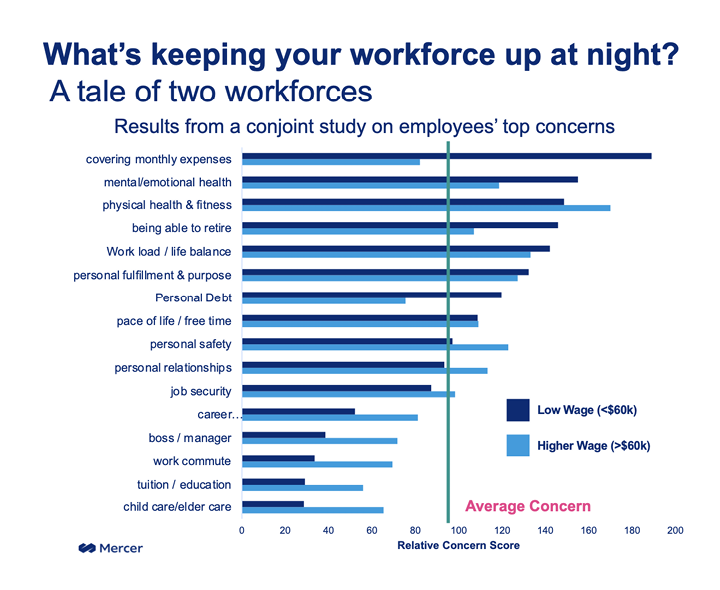
“It’s hard to think about your future, planning for retirement, and planning for your children’s education when you can’t pay your monthly bills,” she said.
“But it’s not lost on that group. It’s something they’re concerned about.”
The top concerns for high wage workers were health, work-life balance, and personal fulfillment and purpose.
Solutions Approach
Bucello stressed that when trying to solve these problems, it is crucial to look at each person as an individual, instead of focusing on one aspect of them such as their income level or where they live.
“Supported employees are more loyal to their employer, they’re more productive at work, they’re living healthier lifestyles, and they’re happier,” Bucello said.
“Supported employees are more loyal to their employer, they’re more productive.”
Bucello
“But not every employer is going to be able to have the appetite to dig that deeply and be able to look at it on an individual basis or even a group basis with personas.
“That doesn’t mean that you’re not able to create a meaningful program to support your employee population, better engage them, and move the needle on satisfaction and loyalty.”
Bucello highlighted three policies highly valued by employees: flexible working arrangements, time off allowed during the workday to spend on health and well-being appointments, and the ability to customize benefits packages to meet their personal needs.
Mental Health Support
In addition, Bucello said nearly half of all employees surveyed valued a wide range of mental health support, with reduced costs for mental health treatment topping the list.
The survey also showed the benefits of employers supporting employees.
Of the employees who reported receiving good or very good support during the pandemic, 45% said they were less likely to leave their job due to that support, compared to just 24% who received fair or poor support.
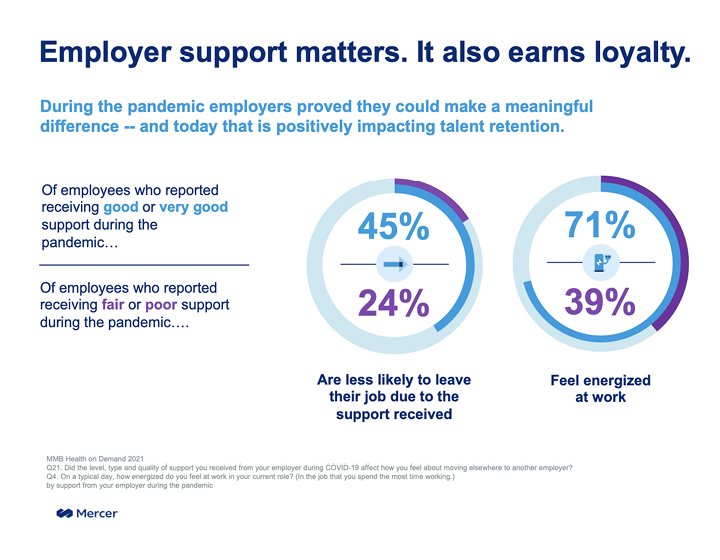
And of those who said they received good or very good support, 71% said they feel energized at work, compared to only 39% who received fair or poor support.
“Employer support matters, it also earns loyalty, and it works,” Bucello said.
“Your employees are responding to what they’re feeling from their employer.”
Key Actions
Bucello concluded by laying out four key actions employers can take to navigate the competitive labor market and make employees feel valued.
The first is to identify and prioritize the population that is at the highest risk of leaving.
The second is to take steps to mitigate burnout and support the mental health of employees.
Third, create a psychologically safe and inclusive workplace embracing diversity.
“Make sure people feel safe.”
Bucello
“Make sure people feel safe,” Bucello said.
“Not just their benefits programs, but the culture within the organization says ‘I’m a safe place for you to come to work and voice your concerns.’”
The fourth and final action is to continue to offer flexibility through the pandemic and beyond.
“We have to start shifting in order to attract and retain,” Bucello said.
“It’s not an easy undertaking,” she continued, “but it’s important, and it matters.”
Healthcare’s Future: The Post-COVID World was made possible through the generous support of JPMorgan Chase Bank with additional support from Deloitte and Pullman & Comley.
RELATED
EXPLORE BY CATEGORY



Stay Connected with CBIA News Digests
The latest news and information delivered directly to your inbox.

CBIA IS FIGHTING TO MAKE CONNECTICUT A TOP STATE FOR BUSINESS, JOBS, AND ECONOMIC GROWTH. A BETTER BUSINESS CLIMATE MEANS A BRIGHTER FUTURE FOR EVERYONE.